
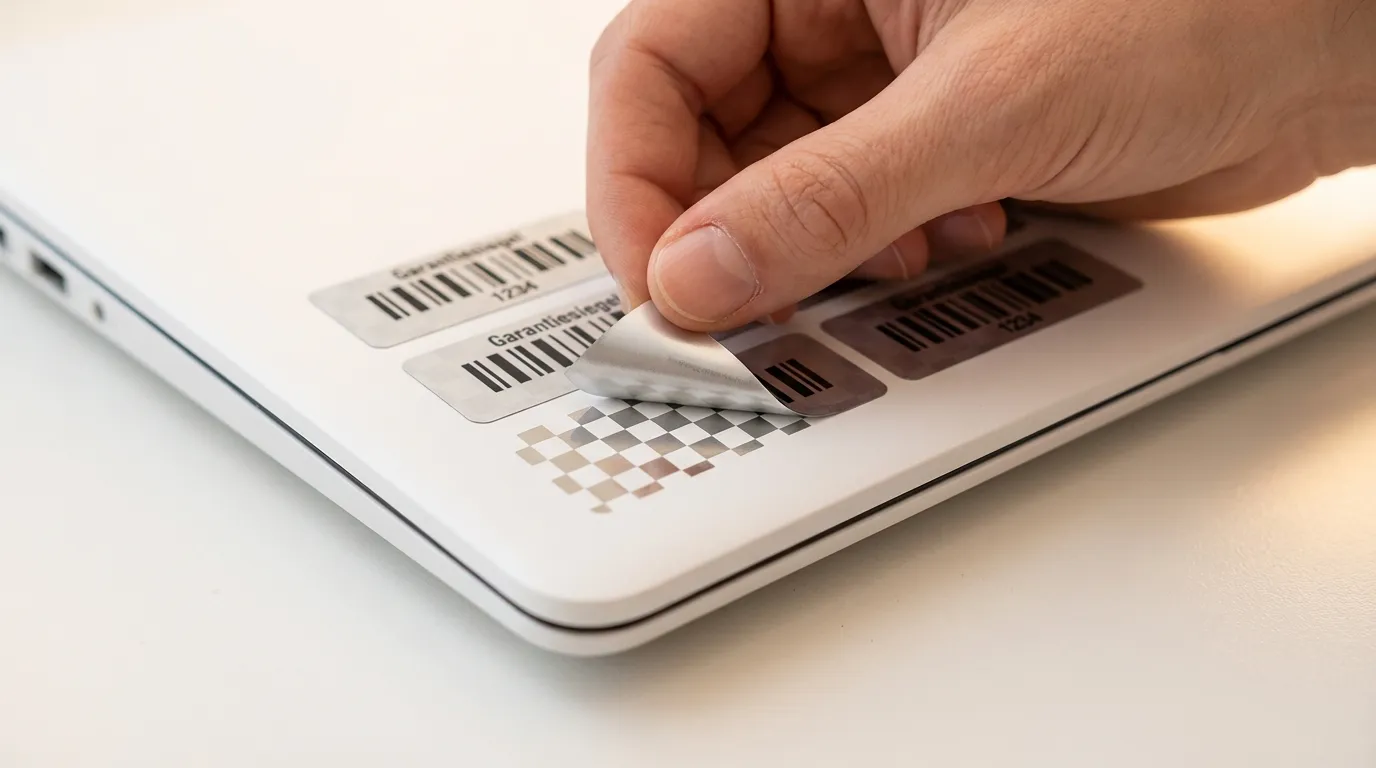
Seal labels with a chequerboard pattern – tamper-evident protection for businesses
Tampering, theft and unauthorised opening of equipment or packaging cause millions of pounds worth of damage every year. Tamper-evident labels with a chequerboard pattern offer reliable, cost-effective protection: As soon as someone attempts to remove the label, the security adhesive leaves a clearly visible chequerboard pattern on the surface. Tampering is immediately apparent. In this guide, we explain how security labels work, which variants are available and in which industries they are indispensable.
How does the checkerboard pattern work on security labels?
Security labels consist of a printable top film and a special security adhesive with an embedded checkerboard pattern. When the label is peeled off, the layers separate: the adhesive with the clearly visible checkerboard pattern remains on the object to which it was attached. At the same time, the top layer of the label is destroyed – re-application is impossible.
The effect is irreversible: neither heat, solvents nor cold can restore the original condition. This makes tamper-evident labels particularly suitable where clear proof of first-time opening is required. After approximately 24 to 48 hours of adhesion on smooth surfaces, the security adhesive reaches its full effectiveness – after which any attempt to remove the label is irrevocably visible.
What types of tamper-evident labels are available?
Seal labels with barcodes combine tamper-evidence protection with unique identification. Each label bears a sequential number as a Code 128 or Code 39 barcode. This allows every sealed device or package to be tracked seamlessly in inventory management.
Seal labels with QR codes and Data Matrix codes enable digital capture via smartphone or handheld scanner. The 2D code can store more information than a traditional barcode – such as serial numbers, test data or links to a digital inventory system.
Seal labels with customised text also feature a freely selectable imprint, such as a company name, inventory number prefix, department or a warning such as “Warranty seal – warranty void if damaged”.
All variants are made from matt silver PET film – tear-resistant, temperature-resistant and printed using the thermal transfer process. The 36×13 mm format is compact enough for device casings, yet large enough for a clearly legible barcode.
Typical applications for seal labels
Warranty seals and device protection: Manufacturers of electronics, medical technology and machinery seal housings with tamper-evident labels. If the housing is opened without authorisation, the warranty claim is void – and the remaining checkerboard pattern makes the tampering immediately visible. Seal labels are state of the art, particularly for laptops, servers, control cabinets and medical devices.
Packaging protection in e-commerce: In online retail, security labels protect boxes and shipping bags from unauthorised opening during transport. The recipient can immediately tell if the parcel has been tampered with. Luxury goods, electronics and medicines are frequently fitted with this protection.
Document and file archiving: In government agencies, law firms and businesses, security seals secure confidential file folders and document boxes. Every instance of access is visibly recorded by the checkerboard pattern, without the need for electronic monitoring.
IT asset management: Combined with sequential numbering and a barcode or QR code, security labels serve both as inventory identification and tamper-evident protection. If a label is removed – for example, to remove a device from the inventory list – the checkerboard pattern remains on the casing as evidence. Find out more in our guide to IT asset management with barcode labels.
What should you look out for when choosing?
The right security label depends on several factors. Firstly, the surface is crucial: the security adhesive adheres best to smooth, clean surfaces such as metal, glass or plastic, leaving a complete checkerboard pattern. Rough, porous or heavily textured surfaces can diminish the effect – a preliminary test is recommended in such cases.
Printing is another aspect. Security labels can be printed with sequential numbers, barcodes (Code 128, Code 39) or QR codes. Individual numbering makes each label unique and enables seamless traceability in inventory management.
For products that need to be sealed in several places at once, variants with multiple versions per number are ideal (sets of 2 or 4). This ensures that all seals on a single device bear the same number – the assignment remains unambiguous.
Seal labels from Barcodeetiketten.com – formats and options
The Barcodeetiketten.com range includes seal labels in the 36×13 mm format on rolls containing 100 to 1,000 labels. The labels are made from matt silver PET film and are printed using the thermal transfer process. The checkerboard pattern in the security adhesive is standard on all variants.
Available options: security seals with sequential numbering and a barcode for unique identification, variants with a QR code and DataMatrix code for digital scanning via smartphone, versions with customised text, and variants with multiple designs per number (sets of 2 or 4).
All security labels are delivered free of charge within Germany and the EU. Orders of up to 10,000 labels placed by 2.00 pm on a working day are dispatched the same day.
Avoiding common mistakes when using seal labels
The most common mistake is applying them to dirty surfaces. Dust, grease or silicone residues prevent full-surface adhesion – the checkerboard pattern becomes uneven when peeled off or fails to appear at all. Clean the adhesive surface with isopropyl alcohol before application and allow it to dry completely.
Another mistake: testing the label immediately after application. The security adhesive requires at least 24 hours to develop full adhesion. Attempting to peel it off prematurely results in a weak or incomplete checkerboard pattern and may give the impression that the product is defective.
Finally, you should ensure that the chosen label size fits the adhesive surface. A 36×13 mm security label must cover the entire surface for the security feature to work reliably.
Not sure which security label is right for your application? Give us a call on +49 7164 - 918 0456 — we’d be happy to advise you personally.