
Barcode verification labels: 5 advantages over handwritten labels
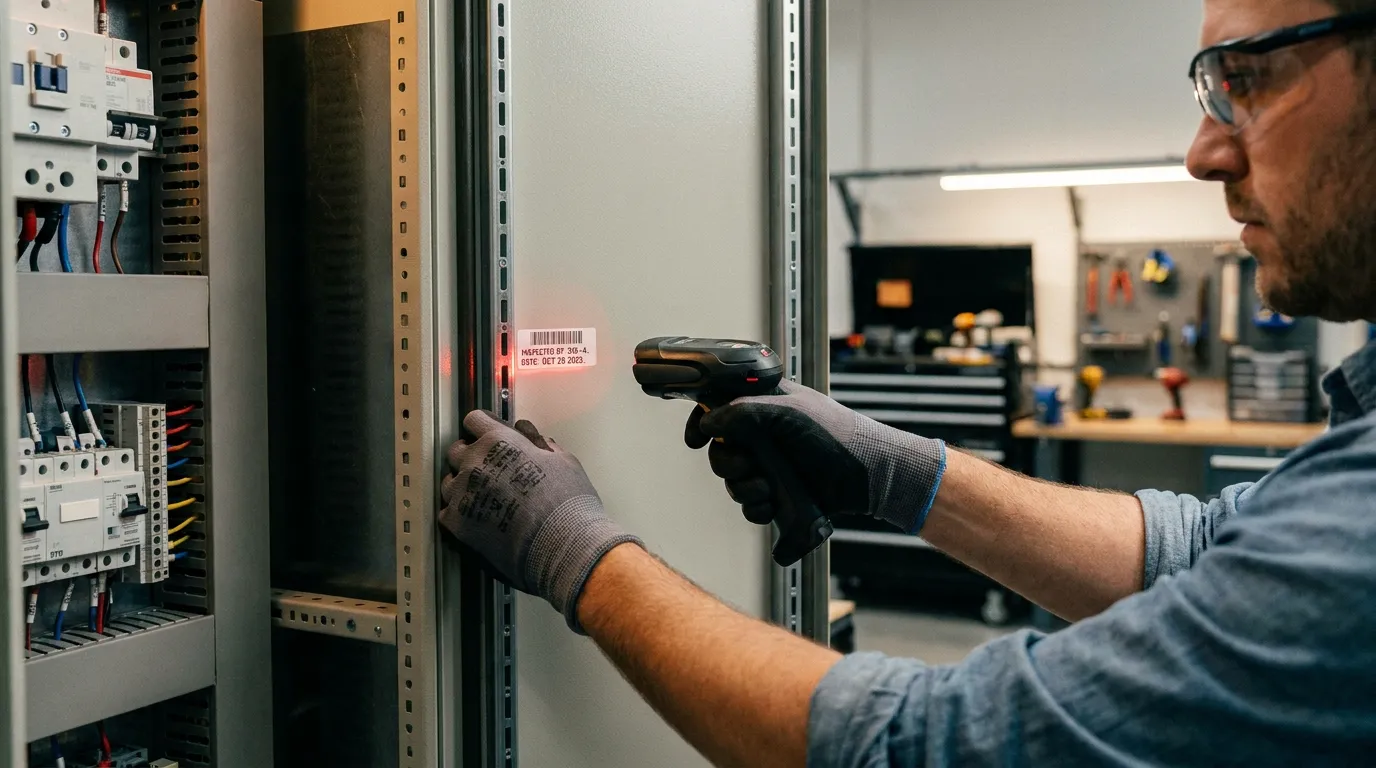
Many companies still label their test items by hand — using a marker pen on the device or a number in an Excel spreadsheet. That works for 20 devices. With 200 or 2,000, it becomes a risk. Barcode test labels solve five specific problems that inevitably arise with manual labelling.
1. Unique identification instead of the risk of mix-ups
Handwritten numbers fade, get covered up or simply become illegible. Two devices with similar numbers (e.g. “0815” and “O815”) lead to mix-ups in the test report. A barcode inspection label bears a machine-readable serial number — unique, forgery-proof and still scannable even after years.
2. Recording in seconds instead of typing errors
Anyone who types serial numbers manually into the test software makes mistakes — studies show an error rate of 1–3% for manual data entry. With 500 devices, that amounts to 5–15 incorrectly assigned test reports per run. A barcode scan takes less than a second and has an error rate of practically 0%. Testers such as the Benning ST750, Fluke 6500-2 or Gossen Metrawatt SECUTEST read the barcode directly.
3. Complete documentation for DGUV V3
DGUV Regulation 3 requires traceable test documentation for all electrical equipment. During an operational inspection, the employer must be able to demonstrate which device was tested and when — and this must be clearly traceable. Barcode test labels create this association automatically: each label is unique with a sequential number, which is assigned to the relevant test report in the test software. Handwritten labelling does not reliably provide this traceability.
4. Time savings during the annual inspection
An external inspection service provider (TÜV, DEKRA, qualified electrician) charges by the hour. Every minute the inspector spends searching, reading and typing costs money. Calculation example: With 500 devices, barcode scanning saves approx. 15 seconds per device compared to manual entry — that’s over 2 hours per inspection run. At an hourly rate of €80–120, this equates to savings of €160–240 per year.
5. Professional appearance
Equipment with neatly affixed, printed inspection labels looks well-maintained and professional — to customers, auditors and your own staff. A uniform labelling system sends a clear message: this company takes occupational safety seriously. This is not just a cosmetic issue — first impressions count during audits and customer visits.
Conclusion: When is it worth making the switch?
For very small businesses with fewer than 30 devices, handwritten labelling may suffice. However, as soon as an inspection service provider uses a scanner, more than 50 devices are inspected, or the employers’ liability insurance association requires complete documentation, barcode inspection labels are the more cost-effective and legally compliant solution. The investment: from €13.90 per 500 labels — that’s less than 3 cents per device.
Order now: barcode inspection labels in our shop — sequentially numbered, DGUV V3 compliant, compatible with Benning, Fluke and Gossen Metrawatt. Or configure your custom inspection labels using the configurator.
Related guides: Inspection labels vs. inspection stickers · Inspection labels in accordance with DGUV V3 · Inspection intervals in accordance with DGUV Regulation 3