
Inspection labels vs. inspection stickers – what’s the difference?
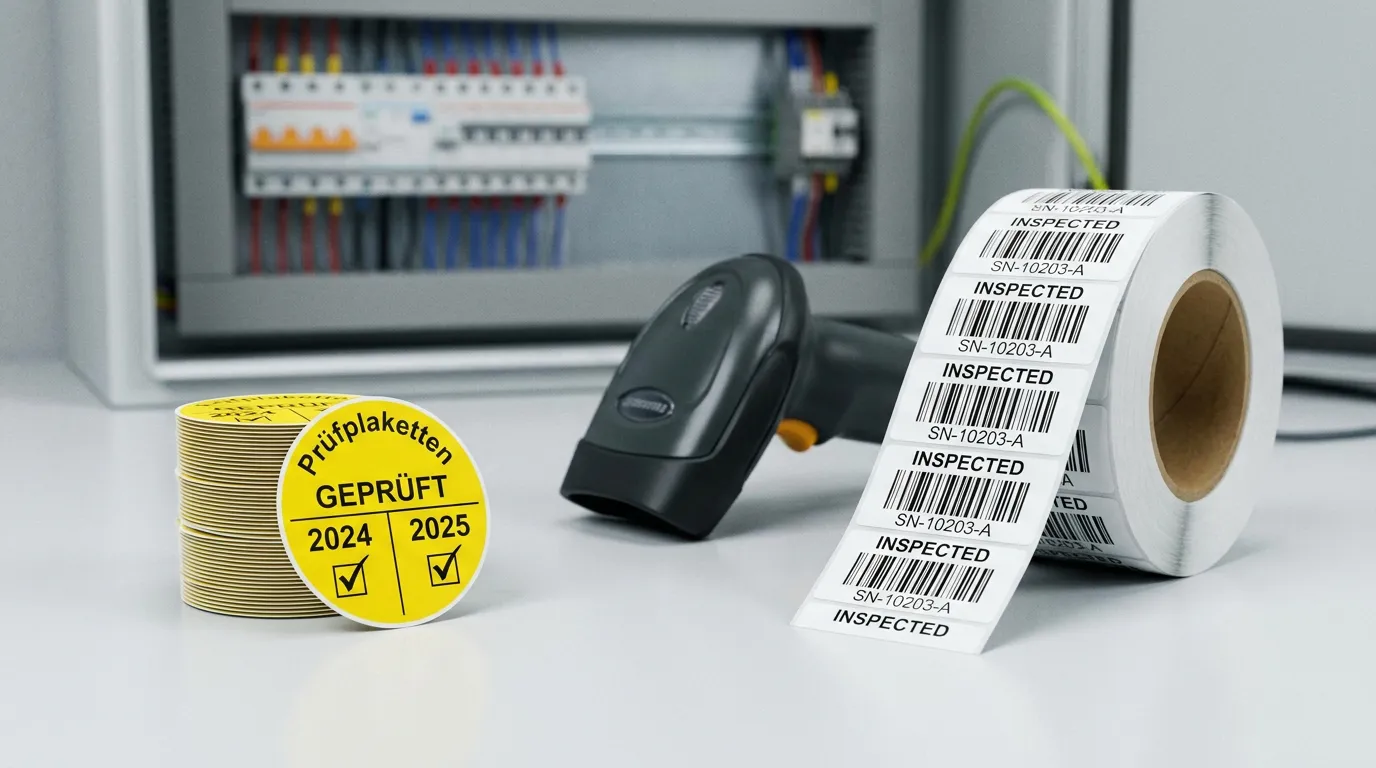
Anyone having electrical equipment, machinery or systems inspected is faced with a seemingly simple question: inspection label or inspection sticker? Both indicate the inspection status — yet they differ fundamentally in form, function and intended use. This guide explains when each solution is the right one.
Inspection stickers: The classic with a colour code
Inspection stickers are round, self-adhesive labels (usually 15–40 mm in diameter) with a month/year scale around the edge. The inspector marks the next inspection date by punching a hole or ticking a box. The colour for each year follows a 6-year cycle (2025 yellow, 2026 brown, 2027 green, 2028 orange, 2029 red, 2030 blue), so that the inspection status is immediately apparent.
Typical applications: ladders, shelving, fire extinguishers, pressure vessels, lifts — wherever a quick visual inspection on site is sufficient and no electronic recording is required.
Inspection labels with barcodes: Digital documentation
Inspection labels (also known as barcode inspection labels) are rectangular labels on a roll which, in addition to the inspection date, feature a sequential serial number as a barcode (Code 128, QR or DataMatrix). Each label is unique and is assigned to the inspection report using a scanner.
Typical applications: Electrical testing in accordance with DGUV V3, IT asset management, medical technology, vehicle fleets — wherever hundreds or thousands of items under test need to be digitally recorded without gaps.
Comparison: Inspection sticker vs. inspection label
| Criterion | Inspection sticker | Inspection label (barcode) |
|---|---|---|
| Shape | Round (15–40 mm) | Rectangular (e.g. 40×15 mm) |
| Identification | Colour code + date | Serial number + barcode |
| Digital recording | No (read manually) | Yes (scanner → inspection software) |
| Traceability | Limited | 100% (every device can be assigned) |
| Device compatibility | — | Benning, Fluke, Gossen Metrawatt |
| Ideal for | Visual inspection, small number of devices | DGUV V3, large test volumes |
| Price (from) | From €8.90 / 500 pcs. | From €13.90 / 500 pcs. |
When is it worth switching to barcode inspection labels?
As long as a business has only a few items to be inspected (fewer than 50 devices) and does not use software, traditional inspection stickers are sufficient. However, once a certain number is reached, manual administration becomes error-prone and time-consuming. Three signs that barcode inspection labels make sense:
1. More than 100 devices requiring testing: From this quantity onwards, manually matching stickers to test reports becomes impractical. A barcode scan takes less than a second — saving hours during the annual inspection.
2. External inspection service providers: Inspectors from TÜV, DEKRA or specialist electricians use test equipment (Benning ST750, Fluke 6500-2, Gossen Metrawatt SECUTEST) that reads barcode labels directly. Without a barcode, the serial number must be entered manually — a source of errors and a time-consuming process.
3. Documentation requirements under DGUV V3: The employers’ liability insurance associations require complete inspection documentation. With barcode inspection labels, every device is uniquely identifiable and linked to each inspection report — traceable even years later.
Combining both: Inspection sticker holders
The most elegant solution for businesses that need both: an inspection sticker holder combines a rectangular barcode label (serial number + header) with a round holder for coloured inspection stickers. This gives you digital traceability and the familiar colour coding on a single sticker.
Conclusion
Inspection stickers and inspection labels are not mutually exclusive — they complement each other. For simple visual inspections on ladders and shelving, the round sticker remains the standard. For systematic electrical testing in accordance with DGUV V3 with software integration, barcode inspection labels are the more efficient option. The key question is: Do I just need a visible inspection date — or a digital inspection history for each device?
Guide tip: Find out more about barcoded inspection labels in our shop — sequentially numbered, DGUV V3 compliant, from €13.90. Or use our inspection sticker configurator for customised stickers.
Related guides: Inspection labels in accordance with DGUV V3 · How to apply inspection stickers correctly · Inspection intervals in accordance with DGUV Regulation 3