
Protective laminate for labels: When is a protective film worth it?
Barcode labels are indispensable in industry, warehouses and administration — but not every label can survive harsh operating conditions without protection. Protective laminate is a highly transparent film that is applied to an existing label and provides long-lasting protection for the print against abrasion, chemicals, moisture and UV radiation. In this guide, you will learn when protective laminate is worth it, what types are available and what you should bear in mind during application.
What is protective laminate and how does it work?
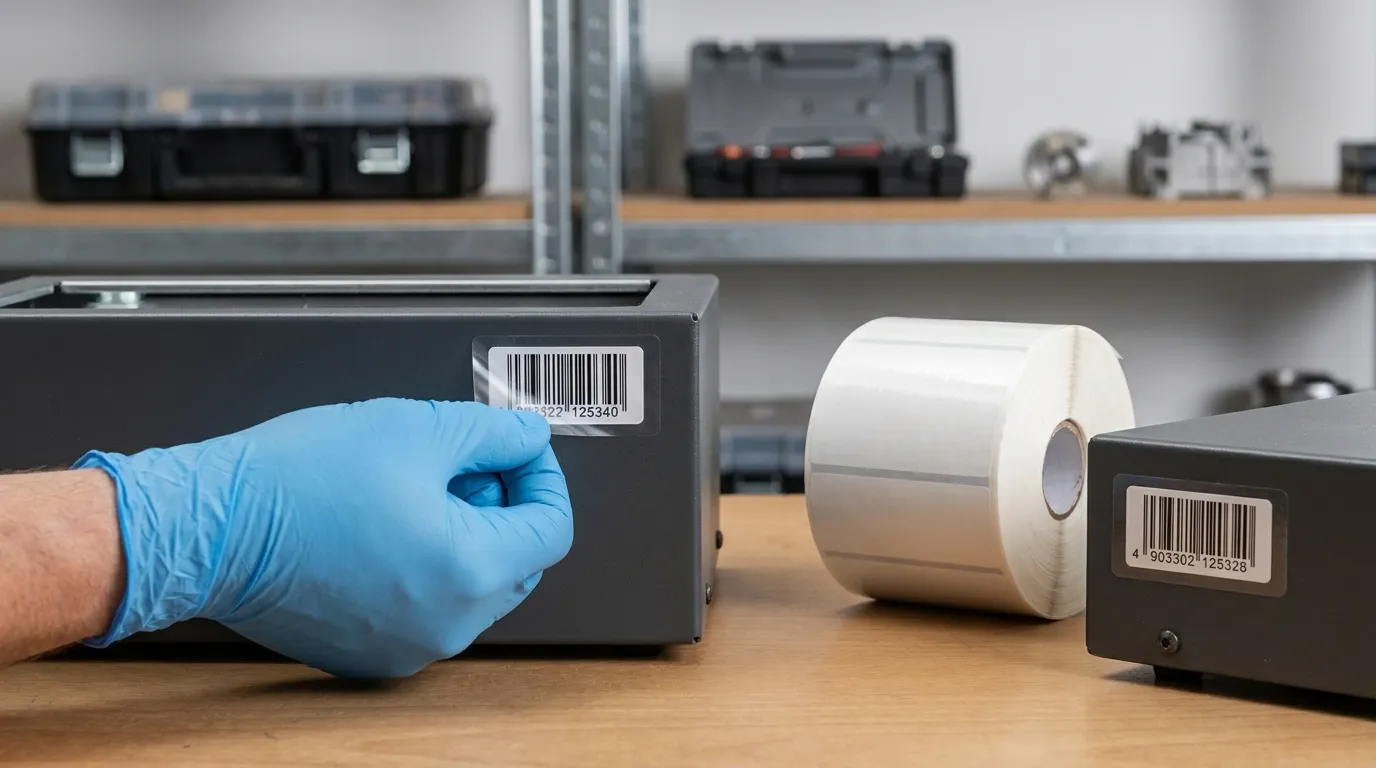
Protective laminate consists of a thin, highly transparent plastic film with a self-adhesive backing. It is applied directly over an existing label to form an additional protective layer. The film is so transparent that barcodes, QR codes and text remain easily readable and scannable.
The process is simple: the base label — whether film, thermal paper or paper — carries the printed information. The protective laminate is positioned precisely over it and pressed down firmly. The permanent acrylic adhesive ensures that the protective film does not peel off, even under stress. At Barcodeetiketten.com, protective laminates are available in 45×25 mm and 76×51 mm formats — suitable for the most common label sizes in inventory and labelling applications.
When is a protective laminate necessary?
Not every label needs an additional protective film. Thermal transfer printed film labels are already very durable and often last for years indoors. A protective laminate becomes useful when particular stresses occur:
Mechanical abrasion: Labels on machinery, tools or transport containers are regularly touched, bumped or rubbed. Without a protective laminate, the print can become illegible after just a few months. With a laminate, a barcode label can even withstand contact with a wire brush without damage.
Chemicals and cleaning agents: In hospitals, laboratories and food production facilities, equipment and inventory are regularly disinfected. Harsh cleaning agents attack the ink — the protective laminate forms a chemical-resistant barrier.
UV radiation and weathering: Asset labels on construction machinery, vehicles or outdoor facilities are exposed to sunlight and rain. UV radiation causes unprotected prints to fade within a year. Protective laminate extends readability to 5 to 10 years in outdoor environments.
Moisture and condensation: In cold stores, car washes or maritime environments, water penetrates beneath the edges of unprotected labels. The laminate completely seals the surface and prevents moisture from seeping underneath.
What types of protective laminate are available?
At Barcodeetiketten.com, two product variants are available, covering different applications:
Protective laminate labels (45×25 mm and 76×51 mm): Pre-cut, transparent film labels on a roll in packs of 100, 500 or 1000. They are applied individually over the label to be protected. Ideal for the targeted sealing of individual labels — such as inventory labels with barcodes or inspection labels.
Protective laminate tape (50 mm wide): A continuous roll of transparent protective film that is cut to size. Suitable for larger labels or custom formats where standard sizes do not fit. The tape is simply pulled over the label and cut to length.
How to apply protective laminate correctly
Application is straightforward, but requires care to ensure a bubble-free result:
Step 1 — Check the surface: The base label must be clean, dry and free from dust or grease marks. If the surface is dirty, clean it first with isopropyl alcohol and allow it to dry completely.
Step 2 — Align the laminate: Position the protective laminate at one edge of the base label. With pre-cut labels, the exact size match is already in place — the laminate covers the label completely.
Step 3 — Apply without air bubbles: Press down evenly from one side to the other, similar to applying a screen protector. A squeegee or plastic card helps to prevent air bubbles. Do not start in the middle — this causes bubbles at the edges.
Step 4 — Press down firmly: Work over the entire laminate with even pressure, paying particular attention to the edges and corners. The permanent adhesive reaches its full bonding strength after approx. 24 hours. Until then, avoid putting any strain on the laminated label if possible.
Typical applications at a glance
Inventory: Inventory labels on office equipment, IT hardware and furniture that need to remain legible for years — particularly when equipment is cleaned or transported.
Industry and production: Labelling of machines, tools and test equipment in workshops where oil, grease and mechanical contact are part of everyday life.
Medical and laboratory: Equipment labels that must withstand regular disinfection cycles using alcohol, aldehyde or peroxide-based agents.
Outdoor and construction: Inventory labelling on containers, construction machinery, generators and vehicles that are exposed to the elements all year round.
Logistics: Pallets, mesh boxes and roll containers, whose labels are subjected to mechanical stress due to constant handling.
Common mistakes when using protective laminate
Incorrect base label: Protective laminate cannot compensate for an unsuitable base material. Anyone using thermal paper outdoors will have a problem despite the laminate — the thermal paper yellows due to heat exposure from the underside. The correct combination is film label + thermal transfer printing + protective laminate.
Testing too early: The adhesive requires 24 to 48 hours to cure fully. If you pull at the corner before this time, you may partially peel off the laminate and assume it is of poor quality.
Dirty surface: Dust, fingerprints or cleaning product residues under the laminate create permanently visible inclusions. Always clean first, then laminate.
Overhanging edges: If the laminate is significantly larger than the base label, sticky edges remain exposed — where dirt collects. The pre-cut laminate labels from Barcodeetiketten.com avoid this problem with precisely fitting formats.
Not sure whether your labels need a protective laminate? Give us a call on +49 7164 - 918 0456 — we’ll be happy to advise you on the best choice of material.