
GS1 Sunrise 2027 – Why Retail is Switching to 2D Barcodes Now
Updated: March 2026 · Reading time: approx. 7 minutes
The classic barcode – the backbone of retail for over 50 years – is getting company. With the GS1 Sunrise 2027 initiative, GS1 has set a global goal for all checkout systems to be able to read 2D codes such as QR codes and GS1 DataMatrix alongside the familiar EAN/UPC barcode by the end of 2027. For manufacturers, retailers, and logistics service providers, this means: Prepare now.
What is GS1 Sunrise 2027?
GS1 Sunrise 2027 is a global initiative from the GS1 organization that introduces the transition from one-dimensional barcodes (EAN-13, UPC-A) to two-dimensional barcodes. The name "Sunrise" stands for the beginning of a new era: By end of 2027, checkout systems worldwide should be able to scan and process 2D codes at the point of sale.
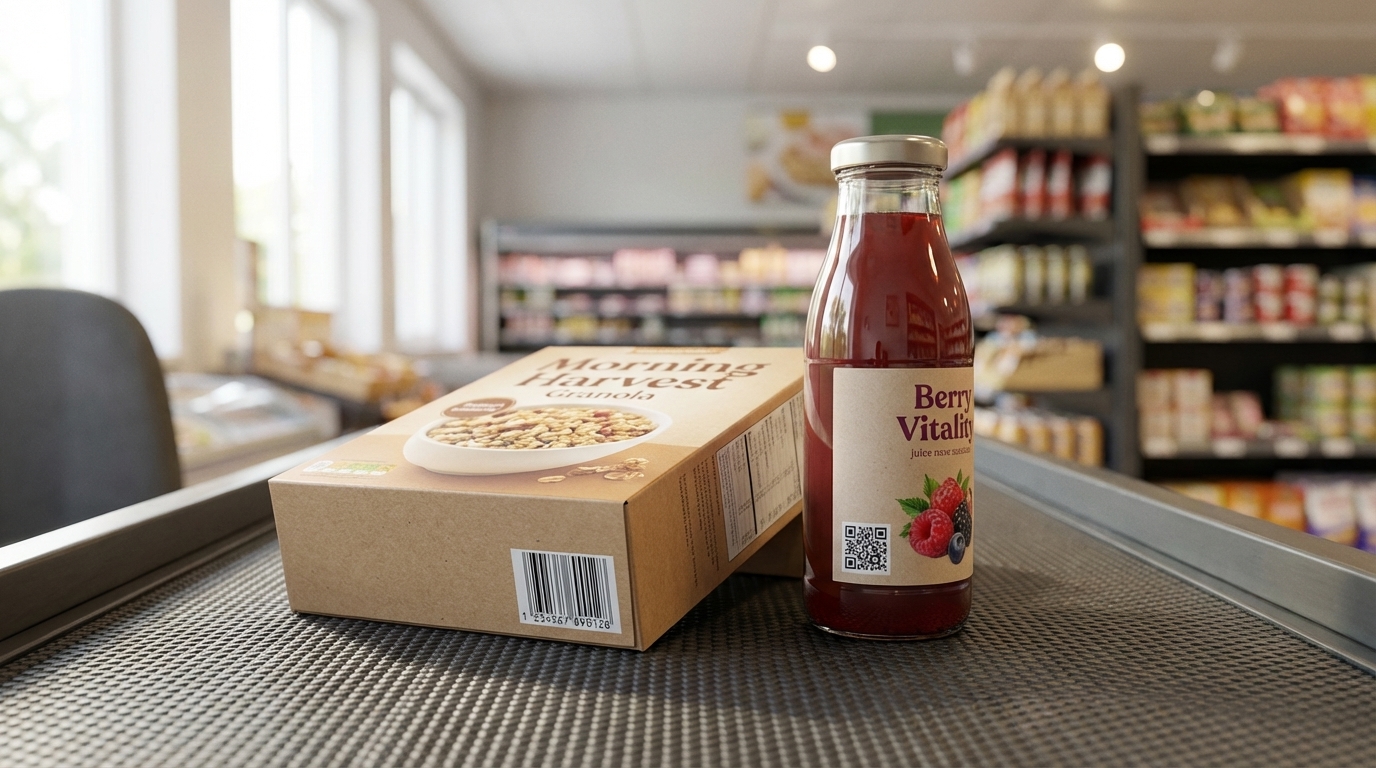
Important: The classic EAN barcode will not be abolished. From 2028 onwards, manufacturers will have the freedom to choose whether to mark their products with a 1D barcode, a 2D code, or both. During the transition phase until the end of 2027, dual labeling is recommended – that is, EAN barcode and 2D code on the same packaging.
Why 2D instead of 1D? The Benefits at a Glance
A conventional EAN-13 barcode stores exactly one piece of information: the GTIN (Global Trade Item Number), which is the 13-digit article number. A 2D code can hold much more:
- More data in less space: In addition to the GTIN, best-before dates, batch numbers, serial numbers, and weight specifications can be encoded – all in a single code.
- Traceability: In case of product recalls, the batch number allows precise identification of affected products – down to individual items.
- Less food waste: Checkout systems can read the exact expiration date from the code and automatically trigger discounts for soon-to-expire products.
- Consumer interaction: Via GS1 Digital Link, QR codes become "intelligent" codes that display product information, instructions, or proof of origin when scanned with a smartphone.
- Space-saving: A QR code often requires less surface area than a classic barcode – especially important for small labels and packaging.
Which 2D Formats Are Being Used?
GS1 recommends two formats for use at the point of sale:
FORMAT 1
QR Code with GS1 Digital Link
Contains a URL structure that can be read by both checkout systems and smartphones. Ideal for products with consumer contact, as the code directs consumers directly to product information when scanned.
FORMAT 2
GS1 DataMatrix
A square or rectangular 2D code without URL structure. Particularly widespread in healthcare and pharmaceuticals. Can be printed on very small areas.
AT Table: GS1 RIM Timeline
| Timeline | What Happens |
|---|---|
| Now – End of 2027 | Transition phase: Dual labeling (1D + 2D) recommended. Pilot projects in 48+ countries are already running. |
| End of 2027 | Target date: All POS scanners worldwide should be able to read and process 2D codes. |
| From 2028 | Free choice: Manufacturers decide whether 1D, 2D, or both go on the packaging. |
Currently, according to GS1, 48 countries that together represent 88% of global GDP are participating in pilot projects. In Germany, GS1 Germany coordinates the transition and supports companies with guidelines and webinars.
What Must Companies Do Now?
For manufacturers and brand owners:
- Check whether your packaging has room for an additional 2D code
- Talk to your printer about the printability of QR codes and DataMatrix
- Register with GS1 Germany if you haven't already to obtain a GTIN
- Begin dual labeling on new packaging layouts
For retailers and logistics providers:
- Check whether your checkout systems and scanners can read 2D codes
- Plan firmware or hardware updates for your POS infrastructure
- Update your inventory management system to process additional data fields (batch, best-before date)
Which Industries Benefit Most?
The GS1 Sunrise initiative affects all industries in which barcodes are used for item identification. Those who benefit most:
- Food retail: Best-before dates and batch numbers directly in the code – less waste, faster recalls
- Pharma & medical technology: Serialization and counterfeiting protection through individual item tracking
- Fashion & textiles: Proof of origin and sustainability information accessible via QR code
- Industry & manufacturing: Component traceability and maintenance information directly on the product
EAN Barcode & 2D Code: Labels from barcodeetiketten.com
Whether classic EAN-13 barcode for retail or QR code labels for the future – barcodeetiketten.com offers both. Our EAN/GTIN/UPC labels are professionally printed on rolls and ready to use immediately. For the transition phase, we offer labels with dual labeling (1D + 2D) – so you're well prepared for Sunrise 2027.
PERSONAL CONSULTATION
Do you have questions about the transition to 2D barcodes or need labels with QR code and EAN? We're happy to advise you personally:
Conclusion
GS1 Sunrise 2027 is not a revolution overnight, but a planned transition that brings retail enormous benefits: more data, better traceability, less waste, and new opportunities in customer interaction. The classic barcode doesn't disappear – it simply gets a more powerful companion. Those who start with dual labeling now are well positioned for the future.