
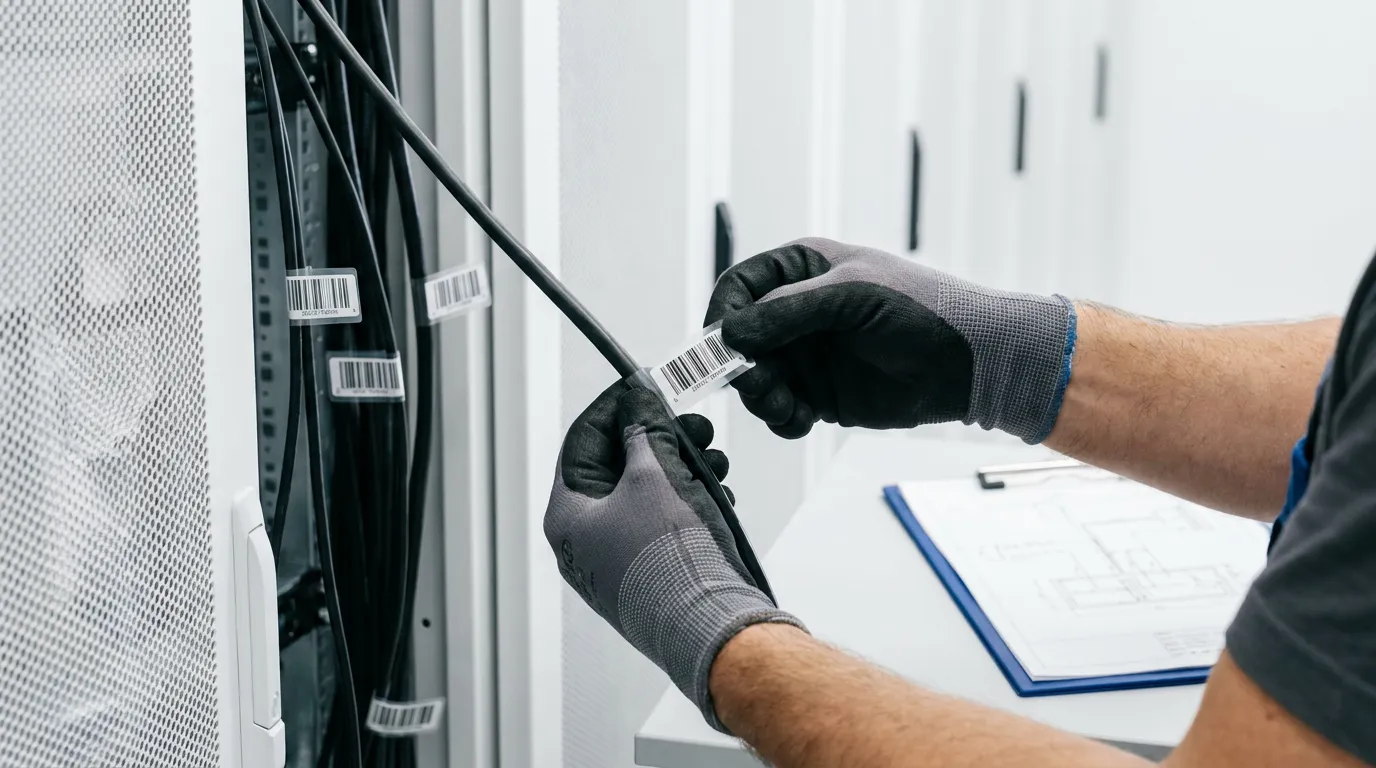
Cable marking with inspection labels in accordance with DGUV V3
Electrical equipment must be inspected regularly and the inspection status clearly documented — this is stipulated by DGUV Regulation 3 (formerly BGV A3). Labelling presents a particular challenge with cables and extension leads: round surfaces, confined spaces and mechanical stress require special cable inspection labels. In this guide, you will learn what requirements apply, which label types are suitable and how you can implement labelling efficiently in your business.
Why is cable labelling in accordance with DGUV V3 mandatory?
DGUV Regulation 3 requires employers to have all electrical equipment inspected at regular intervals by a competent person or a qualified electrician. Cables, extension leads, multi-socket outlets and appliance connection cables are classified as portable electrical equipment and are subject to particularly short inspection intervals.
After each successful inspection, the next inspection date must be clearly documented on the equipment. Without labelling, it is impossible to determine during an operational inspection or in the event of an accident whether the equipment has been inspected. The employers’ liability insurance association may impose fines for a lack of documentation, and in the event of damage, there is a risk of losing insurance cover.
Inspection intervals for cables and wiring
The specific inspection intervals are determined by the competent person as part of the risk assessment. The recommendations in DGUV Information 203-070 serve as guidelines:
Office and administration: Portable equipment every 24 months; up to 48 months is possible for low usage. Workshop and production: Every 6 to 12 months, depending on mechanical and thermal stress. Construction sites: Every 3 to 6 months — the shortest intervals apply here, as cables are exposed to extreme conditions. Laboratories and test benches: Every 6 to 12 months, particularly where there is contact with chemicals or moisture.
The 2% failure rate serves as a guideline: if more than 2% of the equipment in a test batch is rejected, the test intervals should be shortened.
Which test labels are suitable for cables?
Cables place special demands on labels: the round surface requires flexible, narrow formats that can be wrapped completely around the cable sheath. Rigid or overly wide labels come loose at the edges and become illegible.
Cable inspection labels with a barcode (approx. 34×70 mm) are the professional solution: They wrap around cable diameters of 5 to 15 mm and provide space for a Code 128 barcode, the inscription “Inspected in accordance with DGUV V3”, the inspection date and the next inspection deadline. The barcode enables digital recording via a handheld scanner — during stock-taking or repeat testing, you simply scan the label and immediately have all the test data in the system.
Cable markers (also Ø 5–15 mm) are suitable for identification purposes only: sequential numbers or freely selectable text for assigning cables to systems, rooms or circuits. In combination with inspection labels, this creates a complete labelling system.
Inspection labels as cable markers with monthly and yearly rings offer immediate visual verification: the authorised person marks the next inspection date by perforating or punching a hole. Recognisable without a scanner — ideal for businesses that do not yet operate digitally.
Material and durability
Cable inspection labels from Barcodeetiketten.com are made of transparent PET film or white film with permanent acrylic adhesive. The transparency offers a practical advantage: the colour of the cable sheath remains visible, so that the colour coding (e.g. black = phase conductor L1, blue = neutral conductor) is not lost.
The material is abrasion-resistant, moisture-resistant and temperature-stable from −20 °C to +80 °C. In workshops and production environments where cables are laid across floors, coiled up or routed around machinery, the labelling remains intact throughout the entire test cycle. For particularly harsh environments, a protective laminate is also recommended to shield the printed side from mechanical abrasion and solvents.
Applying test labels correctly — 5 steps
Step 1 — Clean the surface: Clean the cable sheath at the point of application with isopropyl alcohol or a lint-free cloth. Oil, dust or silicones prevent adhesion.
Step 2 — Choose the position: Apply the label close to the plug or device connection — there it is immediately visible during testing and is subject to less stress during installation. Maintain a distance of at least 10 cm from the kink protection.
Step 3 — Wrap the label: Wrap the label evenly and without creases around the cable sheath. For barcode labels, ensure that the barcode is not distorted by the curve — the scanning surface should lie as flat as possible.
Step 4 — Press down: Press the label firmly for 10–15 seconds. The permanent acrylic adhesive reaches its final strength after 24 hours.
Step 5 — Document: Complete the test report (device ID, tester, result, next date). If using barcode labels, scan the number directly into the test management system or an Excel spreadsheet.
Digital inspection management with barcodes
The combination of cable test labels with barcodes and a handheld scanner significantly speeds up repeat testing. Instead of handwritten lists, you scan the label and see immediately: Which piece of equipment is this? When was it last tested? What was the result of the last test? Even a simple Bluetooth handheld scanner costing from €150 is sufficient to work with an Excel spreadsheet or specialised testing software.
For businesses with hundreds or thousands of portable items of equipment, digital recording is not a luxury, but a prerequisite for comprehensive documentation. During an inspection by the employers’ liability insurance association, you can provide proof of the test history in seconds — without having to trawl through files.
Questions about cable marking? Call us on +49 7164 - 918 0456 — we’ll be happy to advise you on formats, materials and order quantities.