
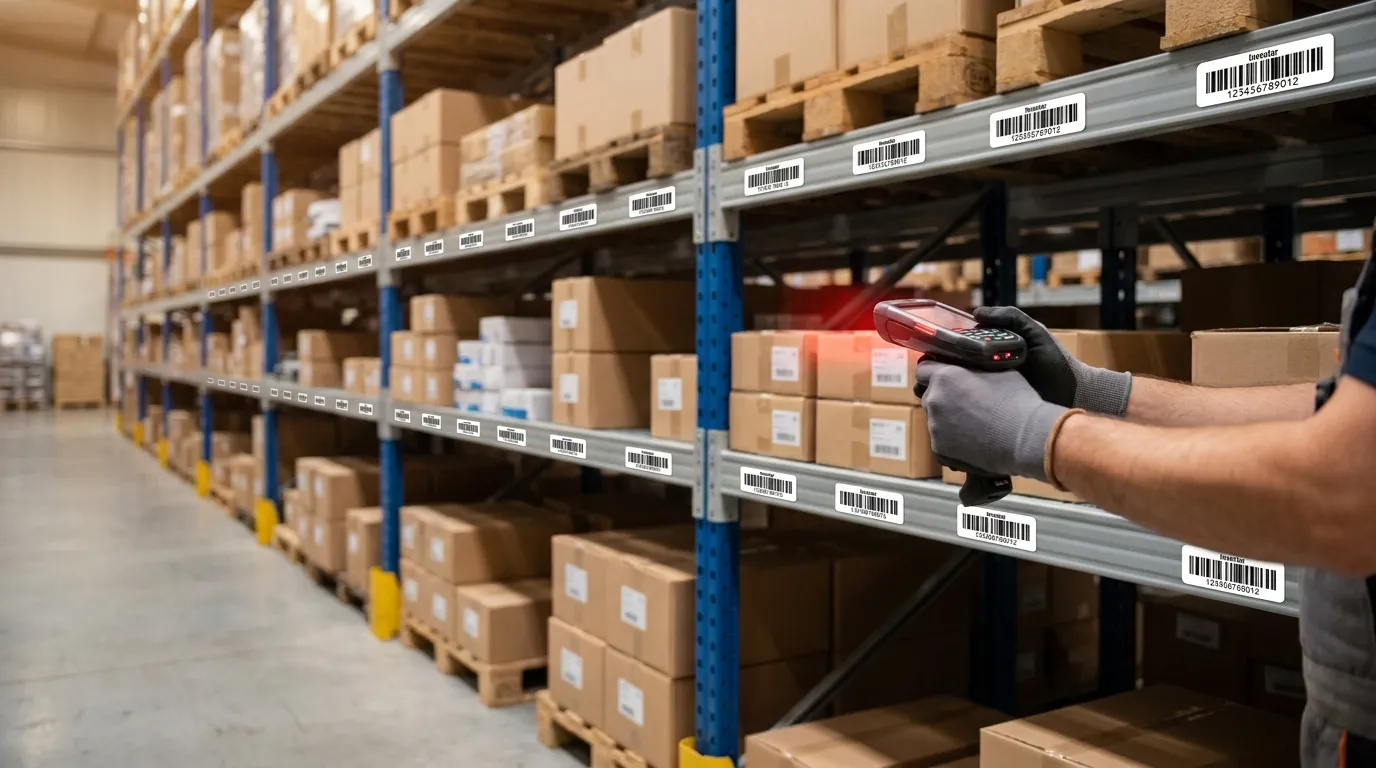
Warehouse organisation with barcode labels: professionally labelling shelves and storage locations
If you want to manage your warehouse efficiently, systematic labelling is essential. Barcode labels for warehouse organisation allow you to provide every storage location, every shelf compartment and every storage area with a unique identifier — thereby significantly speeding up storage, search and picking processes. This guide shows you how to set up a well-designed warehouse labelling system using barcodes, which label materials have proven effective, and what mistakes you should avoid from the outset.
Why barcode labels are fundamentally changing warehouse organisation
An unstructured warehouse costs time and money: staff search for items, incorrectly stored goods get lost in the chaos, and the annual stock-take becomes a nightmare. With a consistent barcode system, these problems can be systematically resolved. Each storage location is assigned a unique location code — for example, in the format “Hall A / Shelf 03 / Bay 02” — which is printed as a barcode (Code 128) on a label affixed to the shelf bay. Scanners read this code in a fraction of a second; mix-ups are virtually eliminated.
The key advantage over manual lists or transparent sheets is that the warehouse management software (WMS) is synchronised in real time with the physical storage location system. When an item is put into or taken out of storage, the employee records it by scanning — without manual data entry. This reduces error rates by up to 80% and saves several hours a day in medium-sized warehouses.
Setting up a warehouse labelling system: step by step
Before ordering the first labels, the location system must be set out on paper. A hierarchical structure that reads from the outside in has proven effective: Hall → Aisle → Shelf → Level → Bin. Typical codes look like this: A-03-02-04 (Hall A, Aisle 3, Shelf 2, Bay 4). The code should be short, descriptive and expandable — a five-digit system is easily sufficient for most SME warehouses.
Next, decide how many labels are required per shelf compartment. We recommend one label per compartment on the front of the shelf at eye level, supplemented where necessary by a smaller label on the shelf upright for aisle scanners. The print format for shelf labels is typically 50×15 mm (narrow format for the edge of the shelf) or 50×25 mm for wall-mounted storage with more reading space.
A pilot phase is particularly recommended for large warehouses: first, fully label one aisle, test the process (stocking, picking, stocktaking) and adjust the system if necessary before converting the entire warehouse.
Which label material for warehouses and shelving?
The choice of material depends on the environmental conditions. In dry indoor warehouses without chemical exposure, white film labels (PET or PE) are sufficient — they are waterproof, scratch-resistant and last for years. For cold stores or outdoor areas, silver or white polyester with UV-stable adhesive is recommended; polyester reliably withstands temperatures from −40 °C to +150 °C.
If the label is to adhere to painted steel shelving or rough concrete walls, permanent acrylic adhesive is the right choice — it remains secure even after years of use. For storage locations that are regularly relabelled (e.g. picking racks with changing items), there are removable variants with a weaker adhesive. A protective laminate extends the service life of barcode labels in heavy-duty environments, where forklift tines or packaging edges scrape against the shelving, by a factor of several times.
Thermal transfer printing is used almost exclusively for printing: the barcode symbols are abrasion-resistant, UV-stable and remain easily scannable even after years — unlike direct thermal prints, which fade and are not suitable for permanent labelling.
Barcode types for warehouse labelling: Code 128, QR, DataMatrix
Code 128 is the industry standard for warehouse bin labels. It encodes alphanumeric characters in a space-saving manner, is readable by any standard scanner and supports the integrated check digit (Mod-103) — reading errors are automatically detected. For a typical location code such as A-03-02-04, a Code 128 label 30 mm wide with a bar width of 0.25 mm is perfectly adequate.
QR codes and DataMatrix are recommended if more information is to be stored on the label — such as a URL to the digital product file or additional metadata. The minimum print size for reliably readable QR codes is 10×10 mm (ISO 18004); 20×20 mm is recommended. For pure shelf labels, however, Code 128 is the more robust choice, as it can still be read reliably even with light soiling or at an oblique scanning angle.
Common mistakes in shelf and storage location labelling
The most common mistake is an inconsistent numbering system: different departments use different codes, or the system cannot be expanded and has to be completely re-designed during warehouse refurbishments. Here, a one-off investment in a clear, hierarchical system pays off over the years.
The second most common mistake: labels in the wrong position. The barcode label belongs on the front edge of the shelf or on the shelf upright — clearly visible to the scanner operator, protected from forklift tines. Labels on the shelf deck or on the back panel are often obscured or damaged.
Thirdly: the wrong material for the location. Thermal paper labels may seem cheaper at first, but they fade in the warehouse heat within months, making expensive re-labelling necessary. Thermal transfer film labels pay for themselves much more quickly thanks to their 5–10-year lifespan.
Finally: no backup system. Labels get damaged, torn off or covered up. A centralised directory of all location codes in the WMS or in a simple spreadsheet ensures that labels can be reprinted quickly in the event of damage.
Warehouse stocktaking: How barcode labels reduce time and effort
With comprehensive shelf and item labelling via barcode, the annual stock-taking process can be significantly accelerated. Instead of paper lists and manual reconciliation, staff scan the storage location code and item barcode one after the other — the warehouse software logs the data automatically. This eliminates incorrect counts, illegible handwriting or duplicate entries.
Anyone wishing to switch to perpetual inventory can do so gradually using barcode labels: first, fully label the fast-moving stock locations, practise the process, and then gradually extend it to the entire product range. Modern handheld scanners are available from as little as €150 and are compatible with almost any warehouse management system (WMS).
Questions about warehouse labelling? Call us on +49 7164 – 918 04 56 — we’ll advise you free of charge and help you choose the right label material and format for your warehouse.
Suitable products for your warehouse organisation
For shelf and storage location labelling, we recommend the following products from the BCE range:
- Inventory labels with barcode — pre-printed with Code 128, consecutively numbered, on rolls of 500 or 1,000, ready for immediate use
- Universal labels — customisable with your storage location code, text of your choice and barcode type; ideal when a specific format such as 50×15 mm is required
- Inventory label range — an overview of all variants (with/without barcode, white/silver film, PET/PE)