
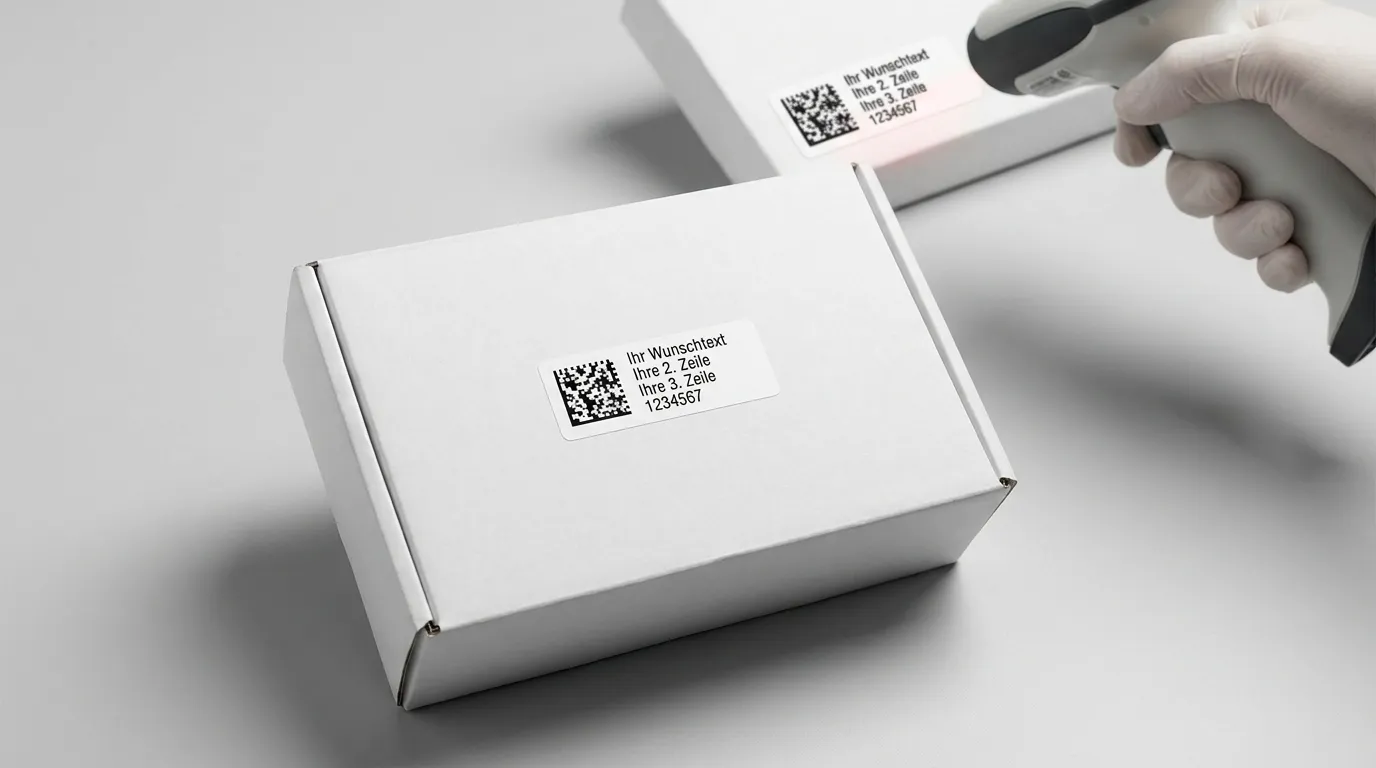
UDI labelling for medical devices: labelling in compliance with the MDR and IVDR
UDI (Unique Device Identification) labelling has been mandatory since the entry into force of the European Medical Devices Regulation (MDR) 2017/745 and the In Vitro Diagnostic Medical Devices Regulation (IVDR) 2017/746. Manufacturers must provide every medical device with a unique, machine-readable code – usually in the form of a GS1 DataMatrix. This guide explains the structure of the UDI, the current EUDAMED deadlines for 2026, and what you need to consider when selecting the right label.
What is UDI and why is it mandatory?
UDI stands for Unique Device Identification and refers to a globally standardised system for the unique identification of medical devices. The aim is to ensure complete traceability from the manufacturer to the patient – both in regular trade and in the event of recalls, complaints or as part of vigilance. The UDI requirement is enshrined in Article 27 of the MDR and Article 24 of the IVDR.
For manufacturers, this means that every product must bear a UDI on the packaging and – where practicable – on the product itself. The UDI consists of two parts and is printed on the label in both human-readable form (HRI = Human Readable Interpretation) and machine-readable form (AIDC = Automatic Identification and Data Capture). A medical device may not be placed on the market in the EU without a correct UDI.
Structure of the UDI: UDI-DI and UDI-PI
The UDI consists of two components:
UDI-DI (Device Identifier) – the static identifier. It uniquely identifies the manufacturer and the specific product model. In the GS1 system, the GTIN (Global Trade Item Number), a 14-digit number, is used as the UDI-DI. The UDI-DI remains the same for all units of the same model.
UDI-PI (Production Identifier) – the dynamic identifier. It describes the specific production unit and, depending on the product type, may consist of a serial number, batch or lot number, date of manufacture or expiry date. For software medical devices, the software version number replaces the serial number.
A typical UDI label encodes this information using GS1 Application Identifiers (AI). Common AIs are: (01) for the GTIN, (11) for the date of manufacture, (17) for the expiry date, (10) for the batch number and (21) for the serial number. All details are encoded together in a GS1 DataMatrix in accordance with ISO/IEC 16022 using ECC-200 error correction.
GS1 DataMatrix: the standard data carrier for UDI
The GS1 DataMatrix is the most widely used 2D code for UDI applications. It offers three key advantages over conventional barcodes: It requires only a few square millimetres of space, can be applied even to curved or very small surfaces, and, thanks to its error correction, can withstand up to 30 per cent damage without becoming unreadable. Scanners can read it from any direction.
The module size is crucial for clear readability. For standard scanners, GS1 recommends a module size between 0.25 and 0.495 millimetres. Smaller modules require special high-resolution scanners. The print quality must comply with Grade 1.5/08/660 in accordance with ISO/IEC 15415 – many testing devices on the market can verify this directly.
Direct Part Marking (UDI-DM) for reusable products
For reusable surgical instruments, an adhesive label is not sufficient: the MDR requires direct part marking (DPM) in this case. Typical methods include laser marking, electrochemical etching or needle marking. The applied marking must withstand all reprocessing cycles and sterilisation procedures permanently.
For all other product classes, a UDI label is required on the packaging – and a separate UDI with its own GTIN on each higher level of packaging, such as the outer carton and pallet. This is the only way to clearly trace the flow of goods throughout the entire supply chain.
EUDAMED and 2026 deadlines
The central hub of the UDI system in Europe is the EUDAMED (European Database on Medical Devices) database. Manufacturers must register their UDI-DI and the associated product data there before placing the product on the market.
A critical deadline is 28 May 2026: from this date onwards, the first four EUDAMED modules – including UDI/Device Registration – must be used. Products that were already placed on the market before 27 May 2026 must be retrospectively registered in EUDAMED by 28 November 2026 at the latest if they are to continue to be sold. Manufacturers should prepare their data in good time and have applied for their GS1 base number (GCP).
Choosing the right UDI label
Not every label is suitable for medical devices. These points are crucial:
Material: For primary packaging in sterile environments, high-gloss white PE or PET films are the first choice. They are resistant to cleaning agents, oils and moisture, and adhere permanently to glass, plastic and metal. Our 40x15mm labels with QR and DataMatrix codes on white film meet these requirements and can be printed on thermal transfer printers using black resin ribbon.
Format: For small sterile packaging, 40x15 mm, 26x22 mm or 50x15 mm are often sufficient. It is crucial that both the DataMatrix and the plain text (HRI) fit side by side and are clearly legible. For larger packaging, 77x16 mm or 100x50 mm labels are ideal, as they provide space for additional information such as the product name, expiry date or warning notices.
Print quality: Thermal transfer printing with a resin ribbon guarantees sharp edges and high durability. Direct thermal printing is only suitable for short-lived packaging, as the print fades when exposed to heat and friction. Regularly verify the print quality using a verifier in accordance with ISO/IEC 15415.
Tamper-evident protection: For particularly sensitive medical devices, tamper-evident labels with a checkerboard pattern are recommended; these are irreversibly destroyed when the packaging is opened, leaving visible evidence of tampering.
Common mistakes in UDI implementation
In practice, the same problems crop up time and again. If you are aware of them, you can avoid them:
Incorrect module size: Data Matrix codes with modules that are too small cannot be read by standard hospital scanners. Strictly adhere to the 0.25–0.495 millimetre specifications set by GS1.
Missing HRI: The UDI must always be readable in plain text as well. If the HRI is missing, the label is not valid for MDR compliance.
Missing packaging levels: Each higher packaging level requires its own UDI-DI with its own GTIN. A single GTIN for the unit pack, outer carton and pallet is not permitted.
Incorrect label material: Thermal paper peels off after a few months or during cleaning. For medical devices, foil plus thermal transfer printing is always required – anything else is a makeshift solution.
EUDAMED registration neglected: From May 2026, no new product may be placed on the market without an EUDAMED entry. This is not a purely formal exercise, but a genuine market access requirement.
Do you have questions about selecting UDI-compliant labels or print quality? Call us on +49 7164 - 918 0456 — we’ll advise you personally and without obligation.